

End times (for the retchingly named Award Season) approach. Which means it’s my preferred moment, several months into the new year, to take stock of the annus prior. Consensus is an often voguish malady. So not for me the über-fêted One Battle After Another, Sinners or Marty Supreme — white elephants all, and Hamnet the treacle-infused excreta festering in their trampled wake.
These mo-pics’s issues are legion. If you ever see me in the wild, feel free to ask why. I’ll probably vent about how PTA has made a failed Jonathan Demme movie (going so far as to steal one of his greatest needle drops) and I wish more people would clock that. Or, that Coogler’s sluggard (not to mention visually, aurally and thematically inept) From Dusk Till Dawn riff has my teeth in perpetual gnash over the botch he’s sure to make of The X-Files. For the other two I’ll just tender catty side-eye and a Zen-neutral “no comment,” life being Lilliputian and all.
Fran Lebowitz’s sardonic dictum — “Do something new!” — remains evergreen. All of my honorable mentions, as well as my Top Ten titles (as always…a ten, not the ten) gave me that longed-for sense of originality — the novel, the imaginative, the (dear lord in heaven) fresh — in what felt like glances, glints, and gleams. Dod Mantle’s fortifyingly grotty widescreen photography in 28 Years Later, for one, or the arid escalations and combustible horrors of Laxe’s Sirāt (a decided “will never watch again” and I mean that as accolade). Spike Lee’s Highest 2 Lowest struck me as an endlessly (re)inventive remake in the vein of Carpenter’s The Thing or Demme’s The Truth About Charlie — easy movies to unthinkingly hate, but gratifying ones to grapple and vibe with for all the aesthetic curveballs thrown and expected tropes upended.
Lucy Liu’s climactic mirror-scream in Presence (one of Soderbergh’s strongest recent efforts) haunts me still, as does Stellan Skarsgård’s magnanimously roguish filmmaker patriarch in Joachim Trier’s Sentimental Value, a Nordic B-side to Almodóvar’s Pain and Glory. The father-daughter relationship in The Phoenician Scheme hit emotionally rich veins that I hadn’t felt in a while from Wes Anderson, and watching cinematographer Bruno Delbonnel, standing in for customary collaborator Robert Yeoman, carve his own distinct visual paths through W.A.’s diag-/dio-rammatic world was no less fulfilling. I finally got Austin Butler in Aronofsky’s Caught Stealing — one of our most humorless and scornfully straight auteurs doing a full-bore genre piece, photographing his often bare-chested and beaten and bloodied leading man like slouchy eye candy, fetchingly attractive to all and sundry.
Neo Sora’s Happyend provocatively portrayed a tech-saturated, surveillance-heavy post-apocalypse with the tenderest of hearts, its on-the-cusp-of-adulthood characters raging against the machine purely by going through the coming-of-age (e)motions. And in other years, Jafar Panahi’s It Was Just an Accident might have been an assured Top Ten highlight, particularly for its unsettling opening in which the film’s ostensible villain steps outside a clearly studio-shot vehicle into what seems an actual nighttime exterior. In this moment, however, the film feels a too-self-conscious step below Panahi’s previous effort, No Bears — that one a real slept-on apogee of the persecuted Iranian artist’s unflaggingly subversive oeuvre.
I wouldn’t use the expected “M-”word for any of my ten favorites outside the top two, possibly top three. Though if “mess” is a more apt descriptor for most of my choices, it’s in the Sophia Petrillo-kidding sense of “mess’a somethin’.” That’s how I like my movies — messas’a somethin’.
I hear all the complaints about the digi-/CG mein of Del Toro’s Frankenstein and I counter with the dually affecting co-lead performances of Oscar Isaac (channeling, as my better half noted, John Barrymore at his cockiest) and Jacob Elordi (his own Brobdingnagian pouting given the proper Gothic context — Ms. Emerald Fennell, grave scarcity of talent notwithstanding, should have taken notes). Jarmusch’s familial triptych Father Mother Sister Brother begins in his usual hipster hermetic register and, through blissful repetition, cuts to a profound emotional quick. I cannot fathom those critiques that say the third, less starry vignette is weakest when it’s the poignant acme of the piece. After the bitterly nihilistic (and I think very funny) The Dead Don’t Die, this is Jarmusch gently self-counterpointing.
The emphatically “political” movies that resonated with me — Kleber Mendonça Filho’s The Secret Agent and Ari Aster’s Eddington — both go for sprawl, though Filho emphasizes the human warmth and solidarity that endures in fascist hellscapes where Aster sees little beyond inescapable, society-razing breakdown (“Good or bad, Handsome or ugly, MAGA or Antifa, They are all equal now.”) Agree/Disagree, Hope/Despair — beside-the-point binaries. I appreciated both films for their oft-volatile shifts in tone, as well as the specificity of their respective recent-past settings, each made vibrantly present.
Derek Cianfrance’s Roofman filled the Demme void in my heart, its true-life tale of a genial grifter holing up in a Toys “R” Us for a clandestinely extended stay suffused with genuine compassion for all onscreen, its anarchically anti-capitalist leanings achieved via steadfast goodwill and decency. And Lynne Ramsay’s Die My Love thrilled me with its jagged-edge vision of a woman unfurling in every way imaginable. Great as Jennifer Lawrence is in the central role, it’s mom-in-law Sissy Spacek (her gun-toting sleepwalk scene maybe my favorite throwaway moment of the year) who makes the reflective and refractive shards of Ramsay’s vision cohere.
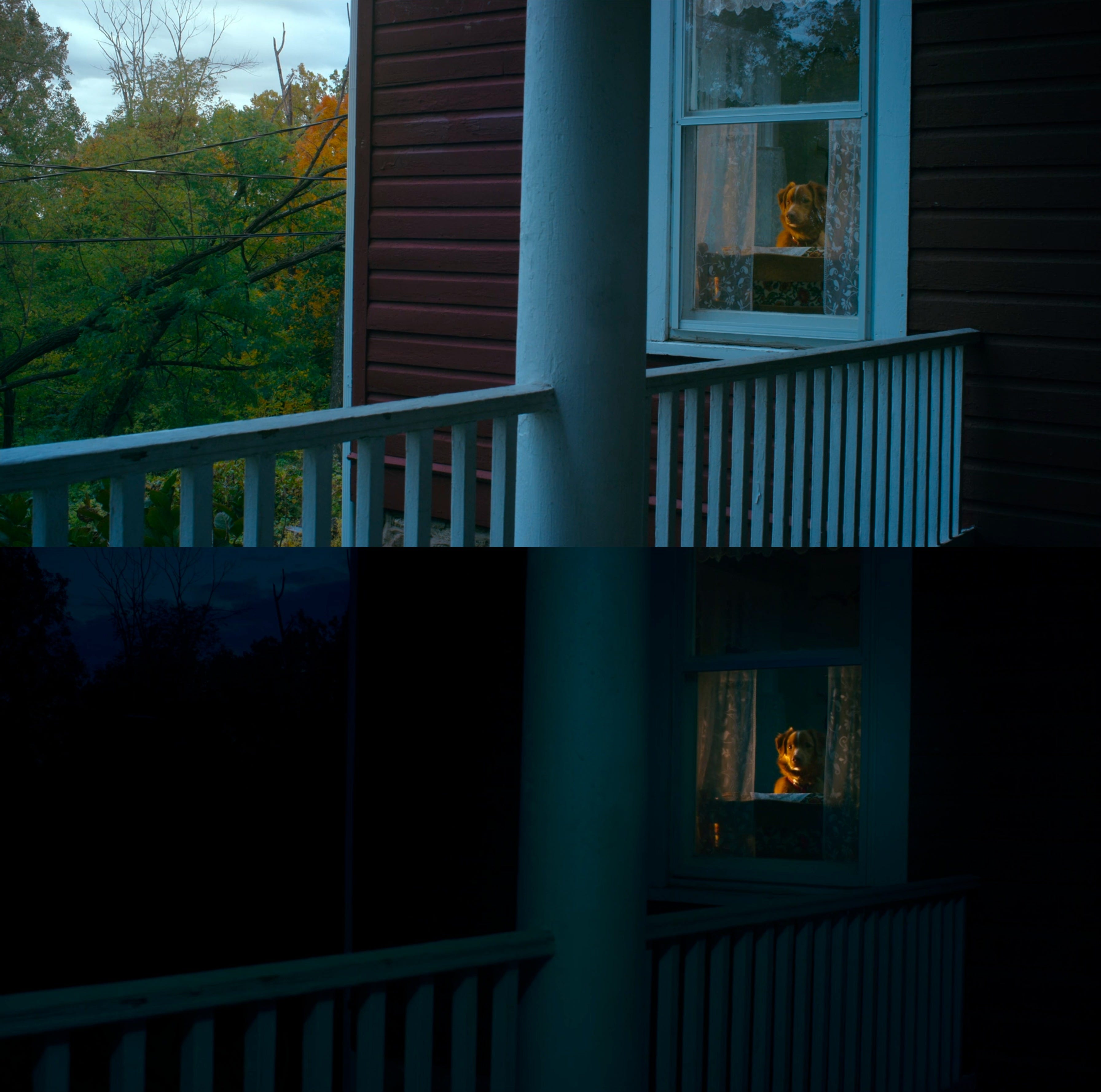
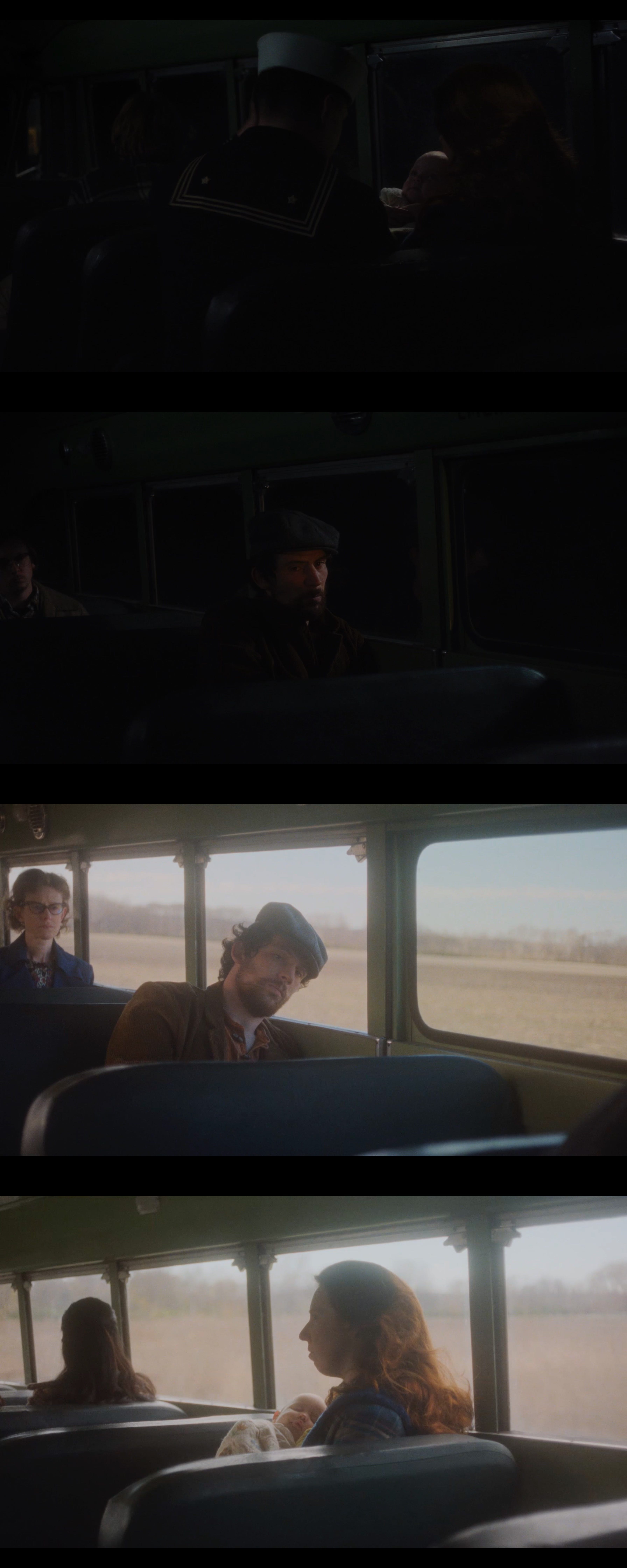
Among their innumerable delights, Ben Leonberg’s petrifying canine-POV horror flick Good Boy and Kelly Reichardt’s incisively idle parable The Mastermind both contain complementary graphic matches that I think get at their respective essences. Specter-besieged furball Indy runs to the window to watch his devoted master head out during daytime. Smash-cut to the pup in the same position many hours later — darkness descended, his trans-species longing quite Kuleshovianly evident. Elsewhere, Josh O’Connor’s Keystone Kop-level art thief (traveling on a nighttime bus to Nowhere-in-Particular, America), spies a woman lovingly conversing with her Navy-uniformed husband and their infant in the seat opposite. Our protag slips off to sleep. Smash-cut to sunrise. Glancing over, he sees the man gone, mother and child frozen in a thousand-yard-stare pieta.
No one escapes history’s times and tides, and I do wonder what it says that my two favorites of 2025 are films I saw in 2024. Different era and all, though I am generally a “same shit, different day” sort, if primarily in the sense of mantra — my profane way of tending those pious foundations that help me to exist in the proverbial Now’s ever-evolving ebbs and flows. Misericordia and The Shrouds (both yes-I’m-gonna-call-them Masterpieces by Alain Guiraudie and David Cronenberg) are “Now” movies that endlessly slip-’n’-slide through interpretive grasp, contorting their way (always sexually, sometimes bone-breakingly) toward transcendence. Guiraudie’s polyamorously perverse pastoral and Cronenberg’s grief-stricken spousal lamentation (the former taking the illusory shape of a black-comic murder mystery, the latter the deceptive contours of a paranoiacally-chilled tech thriller) are transgressive creations honed with uncannily crystalline precision. Two late-career efforts, from virtuosos who have fully lived and practiced the art life, that have the feel of summative statements — particularly in regards to how we might get unstuck, even if only for an evanescent instant, from the mortal coil morass.—Keith Uhlich
The Shrouds
Misericordia
The Mastermind
Good Boy
Die My Love
Roofman
Eddington
The Secret Agent
Father Mother Sister Brother
Frankenstein
Honorables: It Was Just an Accident, Happyend, Sentimental Value, The Phoenician Scheme, Presence, Highest 2 Lowest, Caught Stealing, Sirāt, 28 Years Later
Brava