

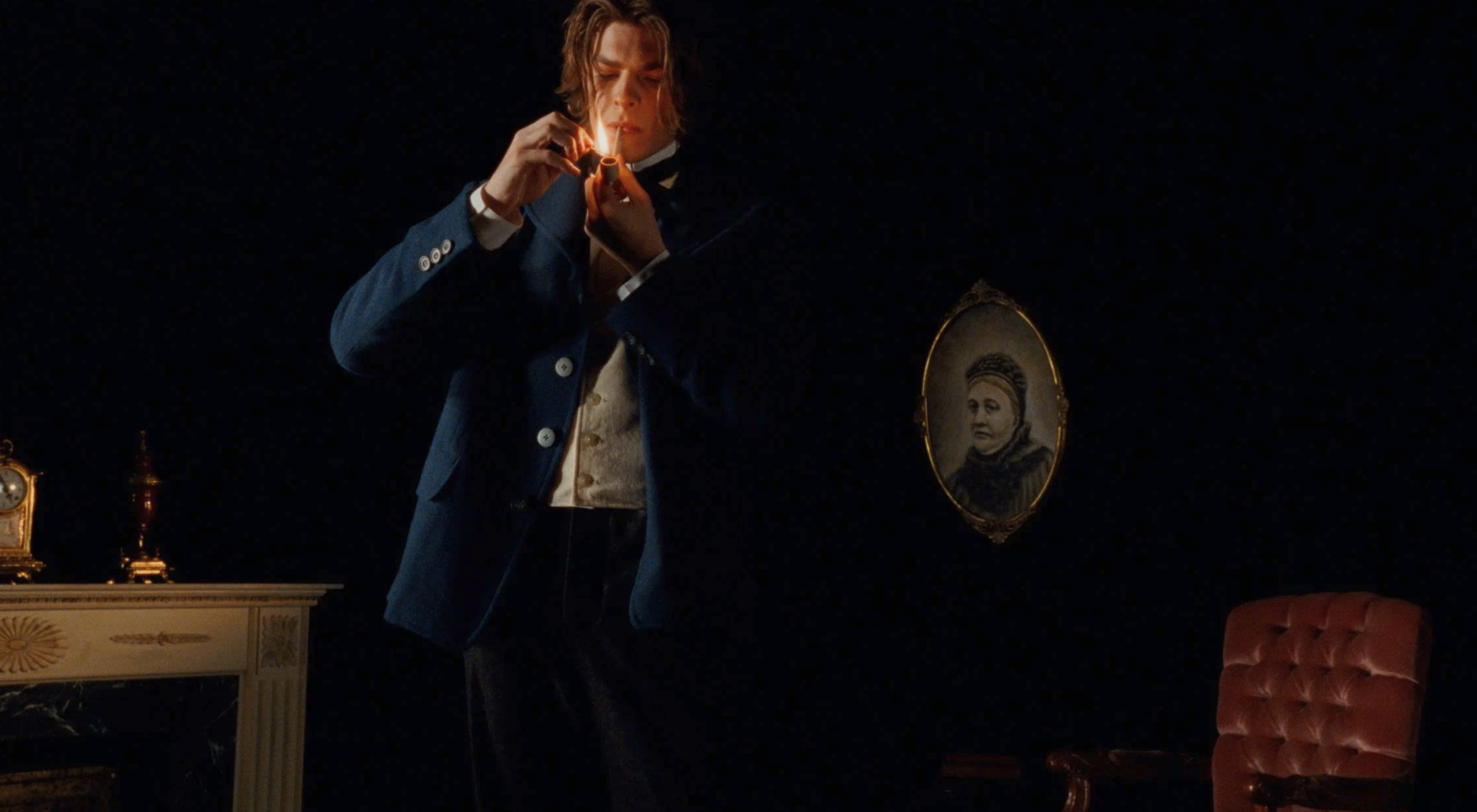
Early days, still, but I suspect I won’t see a better movie this year than Patrick Wang’s A. Rimbaud. Easy to pinpoint precedents (Syberberg, Resnais, Rivette, Straub-Huillet), as well as to presuppose terms like “unconventional” and “overlong” being bandied about by bemused/baffled/bored commentators. I’ll go for my own cliché: It’s its own thing, stem to stern, and gloriously so — a summative work by a genuine artist that rewired my every sense and synapse.
A single actor — the Australian Blake Draper, whose only prior feature is the Disney streaming movie Prom Pact (2023) — is onscreen for the entirety of the 175-minute runtime. He portrays the French poet Arthur Rimbaud from his virtuosically unhinged teen years as the enfant terrible of the Gallic literary scene through to his more rigorous and “reputable” middle-aged exploits as a colonial merchant in Abyssinia. It’s a performance that at first blush feels vaguely raw and ragged (is the callowness on display an amateurish limitation or a (sub)conscious manifestation?) and by the end so precise in its every choice and effect that the full scope of Wang and Draper’s collaborative effort becomes awe-strikingly evident.
Death came for Rimbaud at 37, from bone cancer, and his verse, such as The Drunken Boat and A Season in Hell, ultimately achieved posthumous immortality. Yet much of Rimbaud’s legend rests on more salacious factoids, particularly his stormy relationship with the decade-older poet and writer Paul Verlaine, with whom he lived and traveled for several years before finding himself on the wrong end of a pistol. Theirs was a bad-gay-relationship par excellence, one dramatized (in the very, very worst of ways) in the 1995 feature Total Eclipse, directed by Agnieszka Holland and featuring Leonardo DiCaprio as Rimbaud and David Thewlis as Verlaine.
Verlaine is a crucial, though smaller part of Wang’s feature, and is represented, like most of the supporting characters, by an offscreen musical instrument reportedly played live on set. (Composer Dan Schlosberg oversaw this contrapuntal, often alien-feeling melodic “dialogue” and the musicians are credited onscreen as “Cast.”) Rimbaud himself speaks in a heady English that is at first dizzyingly rhapsodic and then, in later scenes, possessed of a kind of titan-of-industry-sculpted metric, his post-balladry verbiage simultaneously treading the cultivated and the corporatized.
It isn’t quite right to say the character denies his fluttery, flowery youth so much as he keeps it stewingly in check, something evident in the keenly employed prosthetics that emphasize the pushing-40 wordsmith’s loss of looks (that enduring fear of many an elder-gay). Juvenile prettiness still haunts Rimbaud’s features: To my eyes, he seems to morph over the course of the film from a cousin of the stunningly gorgeous Andy Gillet of Rohmer’s The Romance of Astrea and Celadon into a desert-dapper, walking-dead ringer, mustache and all, for Golden Age Hollywood stalwart Ronald Colman. He’s his own graveyard, as Clive Barker might say, squatting amongst the tomb of the person he was.
Wang’s film is an epic physical and psychological journey captured by cinematographer Frank Barrera entirely in a black-box theatrical setting. Rimbaud is first seen before a rocky outcropping that feels like it’s floating in some liminal mind palace, and among the movie’s many amazements is how it reinvents itself visually scene by scene. An early episode in which the young Rimbaud is assaulted during a long night in jail is envisaged via a hulking shadow, a few ominous shakes of the camera, and Draper’s excruciatingly lingered-upon shell shock. Another aesthetic tour-de-force comes as Rimbaud slowly works his way down a long table peppered with pages of his poetry, reading snippets in varying tones (chest-thumping confidence; huffy reticence) while appearing to corporeally transform like an animate embodiment of one of those monkey-to-man diagrams you might find hanging in a school science classroom. When the scene finally cuts to a long shot of Rimbaud, standing at table’s end beneath a soaringly suggestive wooden ceiling frame, this speculative instant from a maestro’s inner life attains a pious sublimity akin to one of Roberto Rossellini’s late-career profiles of Louis XIV, Pascal and the Medici.
Ah, the biopic! Cursed form of cinematic address (not redress) currently enjoying a brain-voided, blood-moneyed resurgence thanks to the shamefully embraced Michael. A more bitter moviegoer might lament the fact that Wang’s film — which he is self-distributing, beginning with ongoing screenings at the Roxy in downtown Manhattan — will not have a fraction of the exposure of that smoothly criminal enterprise. And that not a single festival has yet seen fit to program A. Rimbaud, whatever the perceived challenges to a prospective audience, is its own malefaction worth some hearty reflection by gatekeepers of all stripes and stations.
Yet I think there’s something in the DNA of Wang’s movie that eschews such resentments, that indeed sees the art life as something both steadfastly complex and simply committed to. A vocation practiced with zeal and impossible to turn one’s back on, as implied by an especially moving moment in the film’s climax when the young Rimbaud, conjured as a kind of deathbed specter, elegiacally declaims with the voice of his older self just before confronting the thing all must face: A line break in the collective poem still being written.