

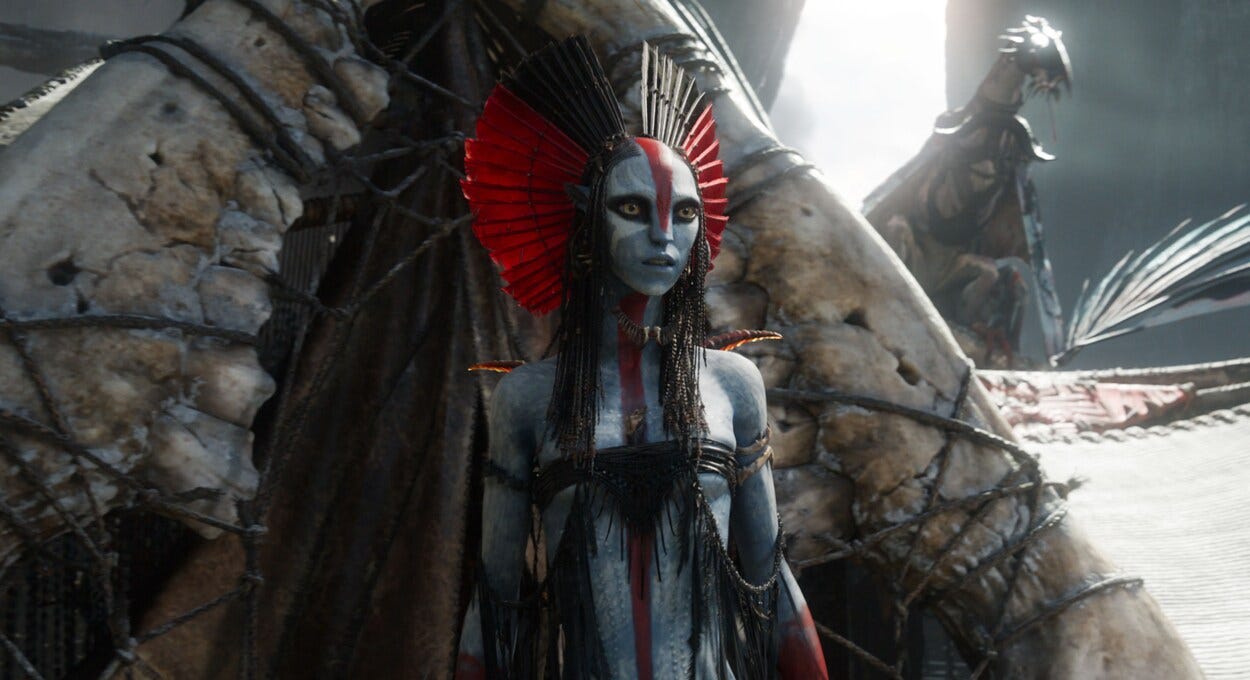
James Cameron’s Avatar: Fire and Ash, the third installment in his ongoing blockbuster sci-fi saga, is effectively a three-hour-plus series of climaxes. The boundless sense of finality proves unsurprisingly wearisome. And it’s also the first time one of these behemoths feels clouded by doubt, almost as if Cameron and his army of technicians are worried that the double-billion-dollar roll of the dice that paid out with both 2009’s Avatar and 2023’s Avatar: The Way of Water might finally come up snake eyes. There’s little doubt Fire and Ash will make money, but will it be enough to justify continuing a tale (two additional entries are planned) that more than a few have dismissively likened to FernGully: The Last Rainforest in space?
…
Everything in Fire and Ash tends to the simplistic and palatable in ways that anyone familiar with Cameron’s oeuvre can clock immediately. He certainly has a talent for glib grandiosity, as exemplified by 1997’s Titanic, with which he turned a horrific real-life historical tragedy into the roller-coaster backdrop for a fatuous harlequin romance.
…
Cameron has gone out of his way to promote his mo-cap techniques as actor-friendly, even concocting a behind-the-scenes short that plays before the movie proper in which he and several of the cast note the many imaginative freedoms afforded by the production as well as the non-use of generative A.I. at every stage. Though, since the two Avatar sequels were primarily shot in 2017 and 2018, the no-A.I. mantra in particular comes off as a disingenuous sop that allows Cameron to appear like an unimpeachable good guy amid the entertainment world’s many villains of the moment.