★★☆☆☆
Dirs. Tom Tykwer, Andy and Lana Wachowski. 2012. R. 2hrs 52 mins. Tom Hanks, Halle Berry, Jim Broadbent.
The thrill in reading David Mitchell’s eras-spanning, genre-hopping novel Cloud Atlas (2004) comes primarily from its stylistic showmanship: six stories set in respective time periods between 1850 and the far-distant future, with each tale authored in a different form — from airport-rack potboiler to solemn speculative fiction with its own invented dialect. Five of the yarns are interrupted midway through, only to be resolved in Russian-nesting-doll fashion after the sixth provides a reverberant narrative center. The rather hoary themes of social oppression, the transmigration of souls and simple acts of kindness echoing through the ages are secondary to Mitchell’s mesmerizing plate-spinning act. The author’s way with words both demands and keeps your constant attention.
By contrast, the independently financed, passion-project film version from cowriter-directors Andy and Lana Wachowski (The Matrix) and Tom Tykwer (Run Lola Run) does little that engages your intellect or emotions. The book’s tales are translated faithfully, story beat by story beat: The 19th-century seafaring saga, “The Pacific Journal of Adam Ewing,” with Jim Sturgess as a sickly diarist; 1930s-set melodrama “Letters from Zedelghem,” featuring Ben Whishaw as a closeted composer; the ’70s paranoia-thriller-aping “Half-Lives: The First Luisa Rey Mystery,” with Halle Berry as a nosy reporter; the present-day comic picaresque “The Ghastly Ordeal of Timothy Cavendish,” with Jim Broadbent as a publisher on the run; the 22nd-century dystopian sci-fi “An Orison of Sonmi-451,” with Doona Bae as a revolutionary Korean replicant; and the postapocalyptic aboriginal adventure “Sloosha’s Crossin’ an’ Ev’rythin’ After,” with Tom Hanks as a cowardly goatherd.
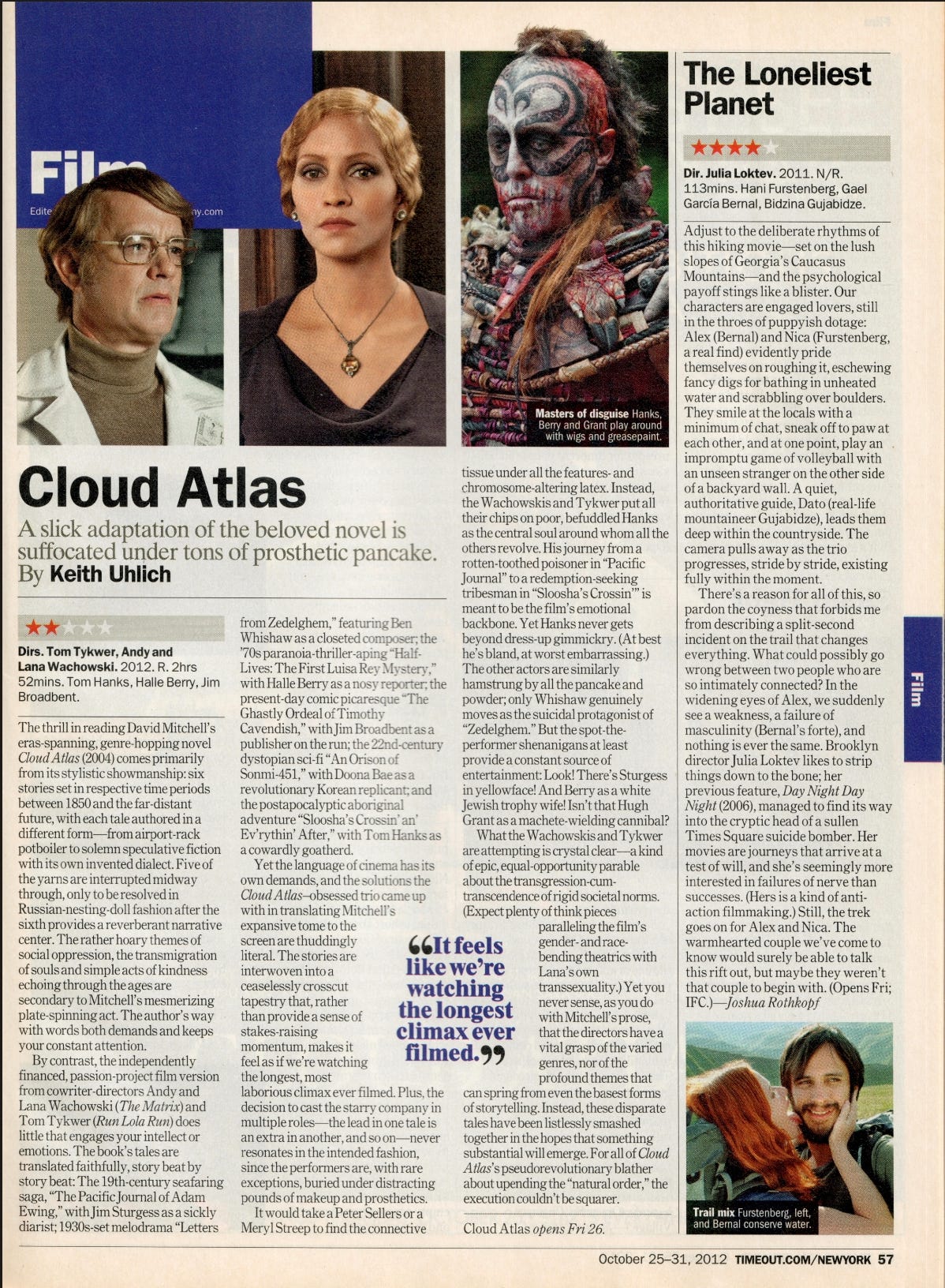
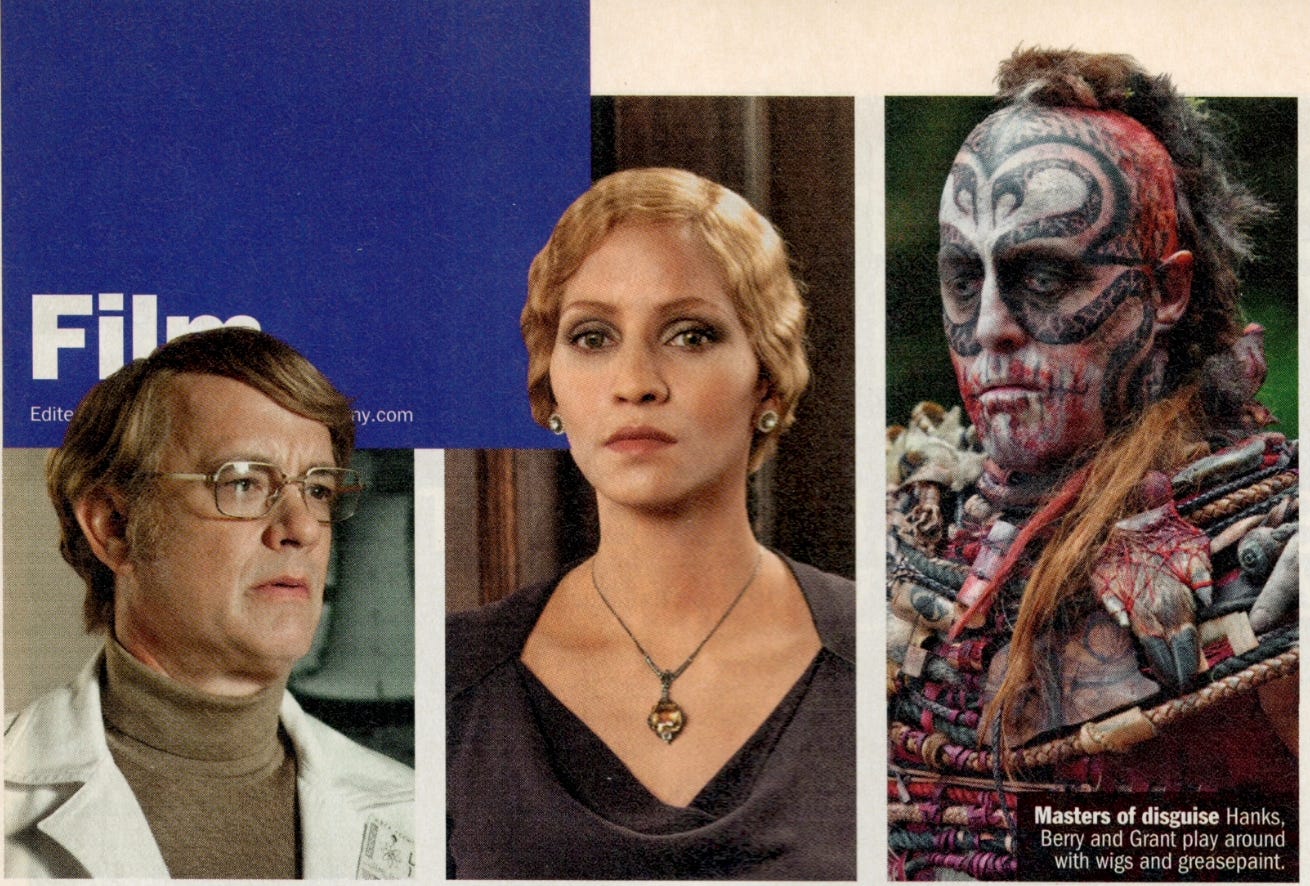
Yet the language of cinema has its own demands, and the solutions the Cloud Atlas–obsessed trio came up with in translating Mitchell’s expansive tome to the screen are thuddingly literal. The stories are interwoven into a ceaselessly crosscut tapestry that, rather than provide a sense of stakes-raising momentum, makes it feel as it we’re watching the longest, most laborious climax ever filmed. Plus, the decision to cast the starry company in multiple roles — the lead in one tale is an extra in another, and so on — never resonates in the intended fashion, since the performers are, with rare exceptions, buried under distracting pounds of makeup and prosthetics.
It would take a Peter Sellers or a Meryl Streep to find the connective tissue under all the features-and-chromosome-altering latex. Instead, the Wachowskis put all their chips on poor, befuddled Hanks as the central soul around whom all the others revolve. His journey from a rotten-toothed poisoner in “Pacific Journal” to a redemption-seeking tribesman in “Sloosha’s Crossin’” is meant to be the film’s emotional backbone. Yet Hanks never gets beyond dress-up gimmickry. (At best he’s bland, at worst embarrassing.) The other actors are similarly hamstrung by all the pancake and powder; only Whishaw genuinely moves as the suicidal protagonist of “Zedleghem.” But the spot-the-performer shenanigans at least provide a constant source of entertainment: Look! There’s Sturgess in yellowface! And Berry as a white Jewish trophy wife! Isn’t that Hugh Grant as a machete-wielding cannibal?
What the Wachowskis and Tykwer are attempting is crystal clear — a kind of epic, equal-opportunity parable about the transgression-cum-transcendence of rigid societal norms. (Expect plenty of think pieces paralleling the film’s gender- and race-bending theatrics with Lana’s own transsexuality.) Yet you never sense, as you do with Mitchell’s prose, that the directors have a vital grasp of the varied genres, nor of the profound themes that can spring from even the basest forms of storytelling. Instead, these disparate tales have been listlessly smashed together in the hopes that something substantial will emerge. For all of Cloud Atlas’s pseudorevolutionary blather about upending the “natural order,” the execution couldn’t be squarer.—Keith Uhlich