

SPOILER WARNING IN EFFECT
“Because in all of the whole human race, Mrs. Lovett/There are two kinds of men and only two/There’s the one staying put/In his proper place/And the one with his foot/In the other one’s face/Look at me, Mrs. Lovett/Look at you!”
That’s one Stephen — Sondheim — placing vengeful dictum on the operatic tongue of bloodthirsty barber Sweeney Todd. “No, we all deserve to die!” Todd howls immediately after, and it’s possible, given how intoxicatingly he rages, that his annihilative ethos comports with Sondheim’s own. Yet the rigidity of the character’s outlook is shown, by musical’s end, to be tragically blinding. Whatever his mortal beliefs, Sondheim, being the deus of this particular machina, does what any great artist must: step omnisciently back to consider the full view — the upside, the downside (there being two sides to every Schwartz) and more beyond.
A literal foot in the (audience’s) face opens another Steven’s — Spielberg’s — unblushingly earnest, philosophically dense extraterrestrial chase thriller Disclosure Day. We’re at a more than vaguely MAGA-coded wrestling show (shades of A.I.: Artificial Intelligence’s Flesh Fair), dropped into a rebellion-in-progress involving surveillance-corp whistleblower Daniel Kellner (Josh O’Connor) and the treasure trove of video evidence he’s stolen that proves the existence of little green men.
Let’s dispense with the gender binary. As the transparently Spielbergian avatar Hugo Wakefield (Colman Domingo) later says of the film’s spindly, clickety-clack vocalizing other-worlders, “They present as animals…” — cardinals, deer, foxes, raccoons — which makes plain their anatomical and metaphorical fluidity. They’re uncannily CGI, in a way that had me wondering, while watching the trailers, if we might be in for some extra-unholy gloss on The Shack. Yet in context, the animals/E.T.’s are “off” in the way of the puppet robin from Blue Velvet, wizened benevolence and Mephistophelian menace inextricably mingled — not unlike, say, casting a premiere avant-gardist (David Lynch) as a second-to-none narrative-ist (John Ford) in a studio-backed recreation of a seminal moment from your coming-of-age.
Dizzying. And that’s how I suspect meeting God would go: So right that it’s not right and you know that but it’s okay but it isn’t really, is it? and on and on and back and forth and sideways, upside down, ad infinitum. And all this as long as you still have your human senses and sensibilities, which, as many would surely say nowadays, aren’t worth the flesh they’re imprinted on. (We all deserve to die.)
Quite a lot for an oft-endearingly goofy, David Koepp-penned genre piece, and there’s more where that came from. Disclosure Day is constructed as a cascading series of narrative and thematic rhymes — opposites constantly, expansively repelling and attracting. It begins in medias res and concludes on a note of evocative ambiguity. The cinematography by Janusz Kaminski initially has an apocalyptic sterility (as if his trademark lens flares and background blow-outs are razing existence Langoliers style) that becomes warmer, seemingly more enamored of the possible (not necessarily the hopeful) as the film goes on.
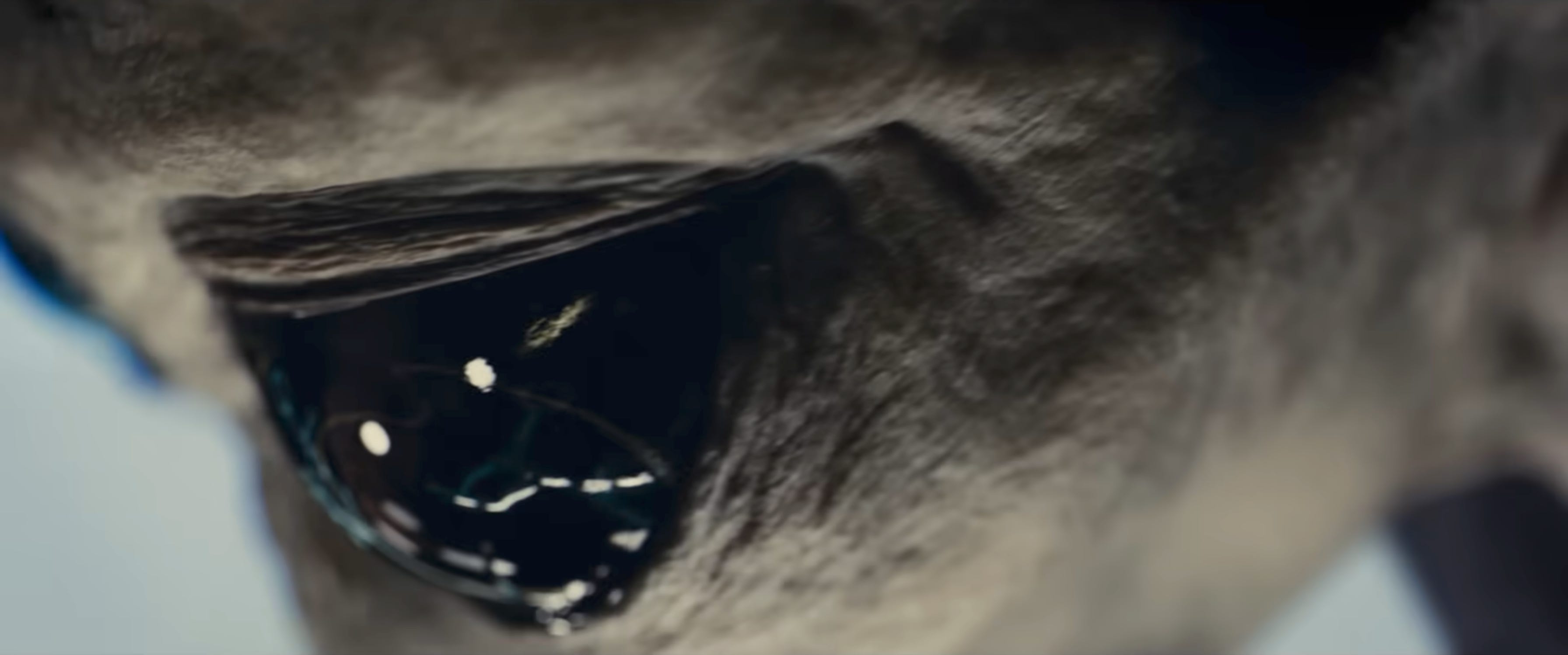
Koepp’s screenplay coupled with Spielberg’s direction allows for didactic discussions of belief and skepticism, suspicion and sympathy, alongside some brilliant show-don’t-tell setpieces. An early confrontation between the hobgoblinish villain Noah Scanlon (Colin Firth) and Daniel’s lapsed-Catholic girlfriend Jane Blankenship (Eve Hewson) revolves around an invasive procedure where one person “drops” into another, the only indicator being a shift in eye color, brown-orbed Noah fiendishly usurping Jane’s baby blues, then wielding her like his own private Manchurian Candidate.
That’s a far cry from the film’s central relationship between Daniel and Kansas City TV weathergirl Margaret Fairchild (Emily Blunt) who share a long-buried childhood trauma on which Hugo, via a wildly immersive recreation of the event, intends to cast some cleansing light. Daniel’s mind is rigorously, antisocially scientific while Margaret’s is flightily, empathically emotional, which makes the parallels with Spielberg’s own parents so incandescently crystal clear you could build the Fortress of Solitude. But the line between the obvious and the obscure is often smudged in Spielberg (my prospective title for a book-length study: Radical Square), which means that Daniel and Margaret not only augment but also reflect and refract each other.
She heedlessly goes with the flow, frequently speaking in prophetic tones and unfamiliar tongues (even mathematical equations, more Daniel’s speed, prove rhapsodically verbal). While he, generally a whirling-dervish of paranoia, beatifically inches himself, in the duo’s first in-person interaction mid-film, toward a sublime moment of connection. “I know you,” he sighs in that emblematic way of an extra-sensorily cowed Spielberg protagonist, the ether of recognition lifting a long-held psychic weight.
A highlight of the director’s oeuvre comes soon after: Having narrowly escaped death by speeding locomotive (in a Proustian-madeleine-like sequence where Spielberg stages his own kinetic elder-version of a formative action setpiece from childhood favorite The Greatest Show on Earth), Daniel and Margaret drop into a train car stocked with pianos that are tied up and stood on edge. The instruments shake back-and-forth with the motion of the vehicle, loosing discordant sounds (surely usual composer John Williams had some input into the aural dissonance) while Margaret has a panic attack. Daniel works to comfort her, eventually placing both their hands on the exposed piano strings, which steadies the jangling music of the spheres and themselves along with it.
To what degree do we have control over universes sole and shared? The question lingers, as do most of the ones posited by Disclosure Day. That title promises concrete answers that, fitting for a blockbuster Hollywood movie of many esoteric contradictions and paradoxes, are not forthcoming. In an early scene, Jane openly wonders what a mass unleashing of knowledge would do to the world; a later discussion with her mentor, Sister Maura (Elizabeth Marvel), couches her struggle through the prism of faith — not in God, but in mankind.
Jane is one of the only characters who appears to have more than a smattering of free will (while still being somewhat puppet-mastered). Most everyone else is prey to the inscrutable whims of the superior intelligence that eventually reveals itself onscreen (not to mention the meta-dictates of a screenwriter and filmmaker who never do). As Margaret notes, and as Blunt expertly conveys in her career-highlight performance, there’s an exhilaration to this out-of-body-while-in-it experience, though there’s a fair share of suffering too (”I will not be anyone’s religion!” she screams at a woman acting a-bit-too-enthusiastically postulant).
The ending, of course, is written. Disclosure is inevitable, as are the Spielbergian swells of emotion that make eyes roll as much as well up. The climax posits a local TV news broadcast as ground zero for release of Daniel’s effective X-files — on one hand a plan easy to tar as shockingly naive (and as my friend and colleague Eric Henderson points out, very much of a piece with the profound mixed-bag that is The Post). Yet it simultaneously has the feel of a galactic grassroots effort — start small, so the global and galaxy-brained solidarity builds and sustains itself. I also don’t think it’s lost on Koepp and Spielberg that there’s something infectious about this slow-and-steady approach that is not burst-and-fade Internet viral. What are the best methods by which we become “sick” (and perhaps salubriously so, though also perhaps not) with the capital-T Truth?
In this case it’s via a close encounter of the third kind, with a being who suggests the world-weary, seemingly benign offspring of the Ark of the Covenant and Doctor Who’s Davros. (And don’t think I didn’t also flash on the gentle E.T. safeguarding mankind’s origins in Brian De Palma’s unfairly maligned Mission to Mars.) A game of Lost in Translation-esque telephone ensues; basically the word of God purred softly and imperceptibly into the ears of the two humans long-prepared to receive it. Now, the world!
For an artist often knocked for his exeunts, Spielberg here comes up with a mic-drop doozy: A camera-within-a-camera shot that filters a last bit of Blunt talk through an aesthetic hall of mirrors, leaving characters and viewers alike balanced on a breathless ellipsis, wondering what, if anything, comes next.